Posts

Heron

Image
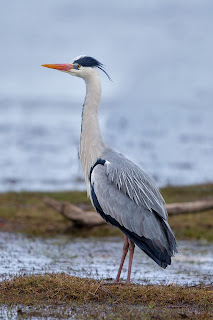
A grey heron  1024px-Graureiher_Grey_Heron.jpg The scientific name for the grey heron is  Ardea cinerea and they are in the bird family herons, storks and ibises. Their population is doing well under The Wildlife and Countryside Act and they have a green UK conservation status meaning they are under least concern. They are very easily recognisable with their tall long legs, long beak and monotone feathering. They feed on fish but do also eat small birds and small mammals such as amphibians. They also eat some rodents after fields are harvested in agricultural areas. They weigh up to 2 kg and have a wingspan of just under 2 m. In the UK there are 13,000 breeding nests and during winter in the UK there are 63,000 individual birds. Grey herons are the largest bird you could see in your garden but despite their size they are very light weight. A pair of heron building a nest.  Ardea_cinerea_building_nest.jpg Herons breed in colones that are called heronries. They ar...

Snowdrop

Image
Snowdrop beginning to flower in early January  Galanthus nivalis,  or snowdrop, are a very familiar sign of spring and of the end of the colder winter months. They are in the family Amaryllidaceae which they share with other perennial and bulbous flowering plants such as daffodils, onions and garlic. Snowdrop are herbaceous plants which means they have no apparent woody steam which aids their identification. They grow from a bulb and are perennial so regrow for many years. Typically they flower in the early months of the year from January through to March. Their flowers do not have petals but have tepals that look like petals. In total they have 6 tepals arranged by the 3 inner tepals being smaller with a notch in the tip with the larger tepals around the edge. Their leaves are fairly narrow and are a dull grey-green colour, smooth to the touch. They grow in damp areas such as moist woodland and riverbanks. When they flower in the early months of the year queen...

Robin

Image
A robin sat in a tree looking out for any danger or food Robin red breasts are familiar garden creatures that are very inquisitive and friendly. They are in the bird family old world flycatchers and chats and have the scientific name Erithacus rubecula . They are considered as many peoples favourite bird and are especially associated with Christmas. There is no difference between the males and the females in the species but the young look different to the adults as they don’t have the distinctive red breast but are spotted golden brown instead. They sing throughout the year and at night sing next to street lights. They do have an aggressive temperament when it comes to territory in order to drive away intruders. The robins diet consists of worms, seeds, fruits, insects and other invertebrates. Robins usually locate their nests on or near the ground in small nooks and crannies, climbing plants or tree roots and any other areas they can find that contain a fully concealed cavit...

Magpie

Image
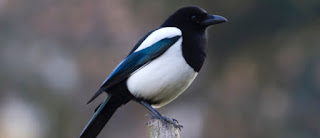
Photo credit: https://www.sciencefocus.com/nature/do-magpies-really-steal-shiny-objects/ The scientific name for the magpie is Pica Pica and they are part of the crow family. Their main diet is omnivorous and they are natural scavengers that source their food from any opportunity they can find. They mainly eat grassland invertebrates like beetles or caterpillars during summer and during winter they have a more plant based diet such as berries or grains. Their scavenger instinct sees them eating household scraps or pet foods and even catch small mammals and birds and sometimes young rabbits. They also take eggs out of other birds nests and consume the young. Magpies save food for later dates by making a small hole in the ground with their sharp beak, put whatever food they have in it and then cover it over to come back to when food is scarce.  They are characterised by their black-and-white plumage, long tails and their nosy, chattery nature, which along with an arrog...

Common ivy

Image
Ivy climbing a tree to reach maximum sunlight for growth The common ivy that most of us pass by day by day is actually called Hedera helix and is a lot more than meets the eye. It is an evergreen plant, which means it doesn't lose its leaves throughout the year, and it can climb heights of up to 30m or 98ft high which is equivalent to just under 7 double decker buses! It is only able to climb due to its specially adapted roots called aerial rootlets. They are roots that are above the ground that contain matted clingy pads that grip onto the substrate and aid the upwards growth of the plant. This adaption allows the ivy to reach maximum sunlight and grow in a niche that few other plants have evolved to be in. This enables the ivy to have a natural advantage when it comes to gaining sunlight for photosynthesis. This unfortunately means that ivy has been accused of strangling trees and blocking sunlight from the trees’ leaves. As the ivy climbs the tree it covers its bark and ther...

Pied wagtail

Image
A pied wagtail in an urban area looking for food The  pied wagtail,   Motacilla  alba,  is  in  the  family  pipits  and  wagtails  and  has  the  status  Green  in  UK  conservation  meaning  it  is  under  least  concern  and  therefore  not  threatened  as  it  is  protected  by  The  Wildlife  and  Countryside  Act  1981.  They  can  be  identified  as  as  adult  but  there  black,  white  and  grey  feathers  and  short,  thin  and  black  beak.  They  are  quite  small  birds  with  a  length  of  18cm,  a  wingspan  of  25-30cm  and  weighing  just  17-25g.  There   population is ...

Winterton beach field trip

Image
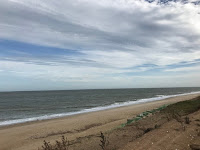
Winterton beach. Sunset on the dunes. One of the first field trips we went on this year was to Winterton beach in Winterton-on-sea which is a small village located on the east coast of Norfolk. There is an extensive dune system on the beach which is a National Nature Reserve of 109 ha. It is a fairly astonishing site as it has not so many ecological similarities with other Norfolk dunes and more with dune systems in the Baltic as it supports acidic plant communities. There are plenty of ranging habitats at the site including coastal sand dunes and freshwater pools. These habitats have resulted in a large amount of biodiversity being present in the area. Sand dune succession had occurred here just like in any other area with sand dunes. On the embryo dunes the pioneer species was marrow grass which is a xerophyte meaning it needs very little water. It begins to stabilise the dunes so other species such as lyme grass and sea couch grass begin to grow. the next stag...