Posts

Monogamy, polyandry, polygyny and polygynandry; are dunnocks the most promiscuous bird?
Image
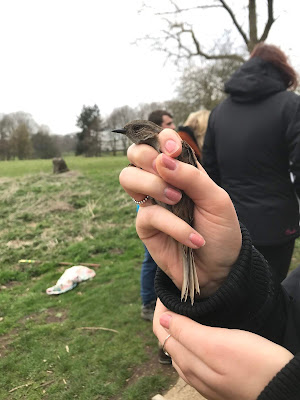
A dunnock having its health observed during a bird ringing session. These beautifully understated birds weigh roughly the same as a 'AA' battery (24 g) and are the same length as two and a half golf tees (14 cm). The dunnock, Prunella modularis are in the bird family accentors and have an amber UK conservation status even though they are protected under The Wildlife and Countryside Act. They are very quiet and unobtrusive birds and are usually seen along flower bed edges or near to bushes. They move in a shuffling gait and come across quite nervy until two rival males meet and then they become very animated and aggressive. Their colouring is quite simple as they are just brown and grey. A dunnock on the look out.  Dunnock-min.jpg Dunnocks have gone through many adaptions in order to use different breeding strategies. Females mate with more than one male in order to make sure her genes are passed onto the next generation and in hope that they will both help rear her c...
Great tit

Image
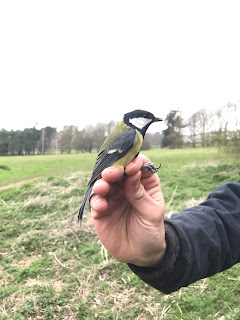
A great tit being held during a bird ringing session, Parus major Great tits are the largest of the UK tits weighing 18 g and are a favourite in gardens and parks. Males of the species have slightly larger bodies than females.  Their striking appearance makes them easily recognisable. The main bulk of their feathers is green and yellow with a black head and white cheeks. In the UK there are 2,500,000 breeding territories making them have the green UK conservation status meaning they are under least threat. As all birds in the UK, they are protected by The Wildlife and Countryside Act of 1981 which forbids intentional killing of the birds. A great tit sitting of a branch of a tree.  talgoxe_johan_n_611.jpg By late January, great tits have found their monogamous pairing and have established their breeding territories. They defend their territories from the end of winter and reoccupy them each year even if one of the pair dies as long as the brood has been successfully ...

Charming birds.

Image
A goldfinch being held during a ringing session. Goldfinches are some of the mist striking birds that can be seen in the UK. They have beautiful feather patterns including yellows and reds. Their scientific name is Carduelis carduelis and they are in the finches bird family. They have a green UK conservation status and are protected, as all UK birds are, under The Wildlife and Countryside Act if 1981. They have a bright red face and a yellow patch on their wings. They are very sociable creatures and breed in loose colonies. They feed on seeds and insects due to their thin beaks allowing them to get to inaccessible seeds from thistles. Primarily, goldfinches feed on seeds but depending on the season their diet slightly alters. In the early months of the summer they feed on things like small plants where as in later summer they feed on thistles A goldfinch in flight.  p0370m7y.jpg The females have the biggest role when it comes to nest making as they build the entire thi...

Leafminer

Image
We used the leaf miner as an example of different methods of sampling. Leaf miners are small flies, moths or sawflies whose larvae burrow in between the two surfaces of a leaf. They can restrict the growth of plants and their health but they are not a massive threat to plants and if the plant is healthy enough to start with then it won't sustain too much damage. Many plants are susceptible to leaf miners including holly, cabbage, citrus trees and shrubs. In spring, as temperatures warm, larvae enter the pupal stage and then appear as young adults in April time. Females lay up to 250 eggs under the leaf epidermis and these eggs appear as raised spots on the leaf. After about 10 days the larvae hatch and tunnel through the mid tissue of the lead whilst feeding on the leaf.  A leaf miner, Liriomyza brassicae,  on a holly leaf. Photo: Olivia Davis In order to estimate the population size of the holly leaf miner, which is what we were doing, the abundance of holly trees in t...

Rabbit

Image
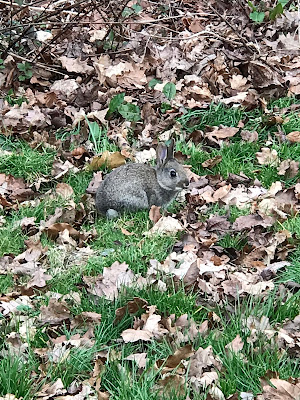
A rabbit looking for food. Rabbits are one of the most loved pet species in the UK. Their small, cute and furry appearance gives them the appeal to be kept as pets. They are around 40 cm long and weigh under 2 kg. Their typical life span is around 3 years depending on whether they are kept as pets or are wild rabbits. They are native to Spain and were originally introduced into the UK for food and fur by the Normans in the 12th century but soon became very common. Rabbits are easily identifiable due to their long ears ad hind legs, grey-brown colour and white fluffy tail. Rabbits and hares are in the same family called  Leporidae  and there are 30 species of rabbits across the planet. They are herbivores which means they eat only plant-based foods mainly including grasses and cruciferous plants, such as  broccoli, but as rabbits are opportunistic feeders, some also eat seeds and fruits. They tunnel underground to create their homes in systems ca...

Pigeons and doves

Image
Pigeons may perhaps be the most commonly known bird in the UK. They are easily identified by their head shape being rounded and small with small slim bills. They also have very rounded bodies with a dense layer of soft feathers with neat, tapered wings. Their legs are scaled and short and they make a distinctive cooing call. The rock dove is the most common type of pigeon and is an ancestor of feral pigeons. Its scientific name is Columba livia and are in the pigeons and doves bird family. They come in many different shades including pale grey, dark blue, green, black, brick-red or cinnamon-brown. Their markings are chequered and darker than their main colour.  A wood pigeon,  Columba livia. Reproduction can occur for them at any time during the year but the peak times are during spring and summer. Once females reach 7 months they are able to reproduce and once mated all pigeons mate for life and once. They build nests from straw and sticks and put it on a ledge such...

The most elite fishers.

Image
Cormorants sitting on a pontoon on the lake at UEA campus. A double-crested cormorant.  Double-Crested Cormorant Cormorants are one of my favourite species of bird. They are larger waterbirds that have a reptilian look due to their long necks. They feed on fish and are normally seen with their wings held out stretched in order to let them dry. They have a wingspan of around 150 cm and weigh over 2 kg. The Uk has very important wintering numbers for global standings. There are 9,018 breeding pairs in the UK and in winter 41,000 individual birds. Cormorants have very powerful beaks which is one way they distinguish with shags. Their scientific name is Phalacrocorax carbo and they are in the bird family cormorants and shags. They are doing quite well under the protection of The Wildlife and Countryside Act which has allowed them to have a green UK conservation status meaning they are under least concern. Due to them being in the same family as shags, they are very similar bir...